The right molder depends on the part. Here is what to verify on any shortlist, and how Kincaid Plastics answers each point.
The best custom injection molder in Florida is the one whose registrations, cleanroom class, press range and tooling terms match your part. Check those on paper. Kincaid Plastics, in Brooksville, is registered to ISO 9001:2015 and ISO 13485:2016, is ITAR registered, runs an ISO 8 cleanroom and 17 presses from 30 to 400 tons, and builds tools in-house.
A “best of” list cannot tell you whether a molder fits your program. A registration, a room class and a tonnage range can. Run the checks below on every custom plastic injection molding supplier on your shortlist, and ask for evidence on each one. Each section ends with how Kincaid Plastics answers.
Quality registrations and their scope
Ask for the current certificate, not the logo. Read the scope statement, the site address and the expiry date. A certificate that covers another site or another process does not cover your part.
ISO 13485 carries regulatory weight in the US. FDA’s Quality Management System Regulation, effective February 2, 2026, incorporates ISO 13485:2016 by reference. 21 CFR 820.1 says its provisions do not apply to makers of components, so a device maker usually carries its requirements to the molder through the purchase order. Ask how the molder handles those flowdowns.
Kincaid Plastics: registered to ISO 9001:2015 and ISO 13485:2016, and ITAR registered.
A cleanroom claim means little without the class. An FDA guidance table, adapted from ISO 14644-1 designations, sets ISO 8 (Class 100,000) at 3,520,000 particles of 0.5 µm and larger per cubic meter, and ISO 7 (Class 10,000) at 352,000. That is a tenfold difference. Ask which class the room holds, whether it is monitored in operation, and whether molding, inspection and packaging all happen inside.
Kincaid Plastics: an ISO 8 (Class 100,000) cleanroom with electric presses and annealing, for medical and electronics work.

These are not quality marks. Under 22 CFR 122.1, anyone in the United States in the business of manufacturing defense articles must register, including a manufacturer that never exports. The same section says registration confers no export rights or privileges. A CAGE code, per FAR 52.204-16, identifies an entity at a specific location. Check that the code matches the plant making your part.
So ask a second question: how does the molder control technical data and access on the floor?
Kincaid Plastics: ITAR registered, and holds a CAGE code.
Ask which press the molder proposes for your part and why. Tonnage alone does not settle it. Mold size, tie-bar spacing, shot size and cycle time decide the fit. For production injection molding, also ask about capacity at your expected quantity and how the molder schedules repeat releases.
Kincaid Plastics: 17 presses from 30 to 400 tons, with runs from a few pieces to 200,000+ units, including insert molding and overmolding.
Ask where the tool is built, who owns it, who approves changes, and who pays for maintenance over its life. Put this line in the total cost comparison, next to piece price. Ask for the maintenance terms in writing, including exclusions. If you have tools in place, ask how a transfer works.
Kincaid Plastics: designs, programs and builds tools in-house, with free lifetime maintenance on every tool it builds. Existing tools can be transferred and run.
Ask to see the lab. Then ask for the equipment list, calibration records and a sample report. Confirm that the lab can measure your critical dimensions at the tolerance on your drawing, and ask when in the run parts are checked.
Kincaid Plastics: an on-site quality lab, with each part inspected.
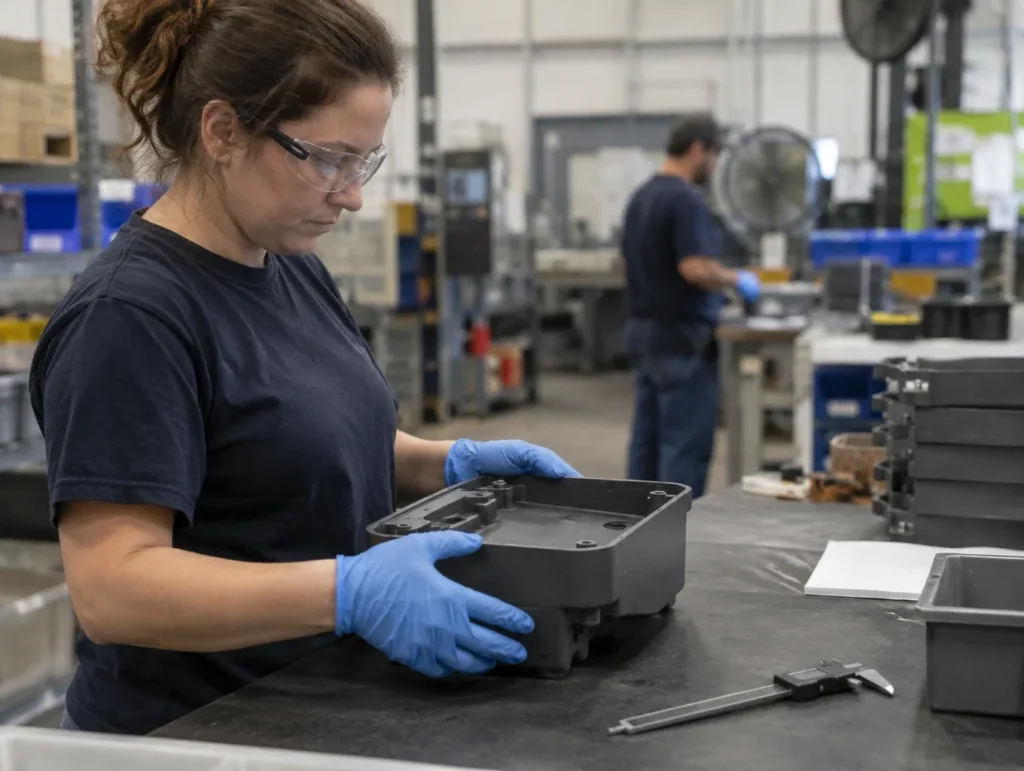
Ask whether the molder has run your grade or a close relative, and how it stores and dries resin. If the grade is open, ask who will help you choose it and what data they will base the choice on.
Kincaid Plastics: runs ABS, PC, PC/ABS, nylon, PP, PBT, PEEK, PAEK, PEI, acetal, acrylic, HDPE, LDPE, PVC, TPE, TPU and TPV, plus glass-filled, carbon-filled and mineral-filled grades. It helps customers select material.
Ask what the molder makes for your sector, then test the answer against the registrations above. An industry on a web page is not a qualification.
Kincaid Plastics: serves medical, aerospace, defense, electronics, industrial and marine customers. See the industries page.
Distance matters for tool moves, quality visits and freight. It also decides how often your team will realistically see the floor. Ask whether you can walk the plant before award.
Kincaid Plastics: 2400 Corporate Blvd, Brooksville, FL 34604, off I-75 north of Tampa. It serves Florida, Georgia, Alabama, the Carolinas, Tennessee and the rest of the Southeast. Customers may visit the floor.
Send the same package to each molder and compare the answers. How a supplier handles the drawing tells you a lot. A good response raises design-for-molding points before it gives you a number.
Kincaid Plastics: engineers review the drawing and quantity range, flag design-for-molding points, then return a quote covering tooling and production, with no obligation. Use the quote form.
Who are the best custom injection molders in Florida?
The answer depends on the part. Compare registrations, cleanroom class, press range, tooling terms and inspection against your requirements. Kincaid Plastics in Brooksville is one option to check, with ISO 9001:2015 and ISO 13485:2016 registration, an ISO 8 cleanroom and 17 presses from 30 to 400 tons.
Does Kincaid Plastics build its own molds?
Yes. It designs, programs and builds tools in-house, with free lifetime maintenance on every tool it builds. Existing tools can be transferred and run.
Does ITAR registration prove a molder is qualified?
No. 22 CFR 122.1 requires manufacturers of defense articles to register, and says registration confers no export rights or privileges. Ask separately about quality systems and how technical data is controlled.